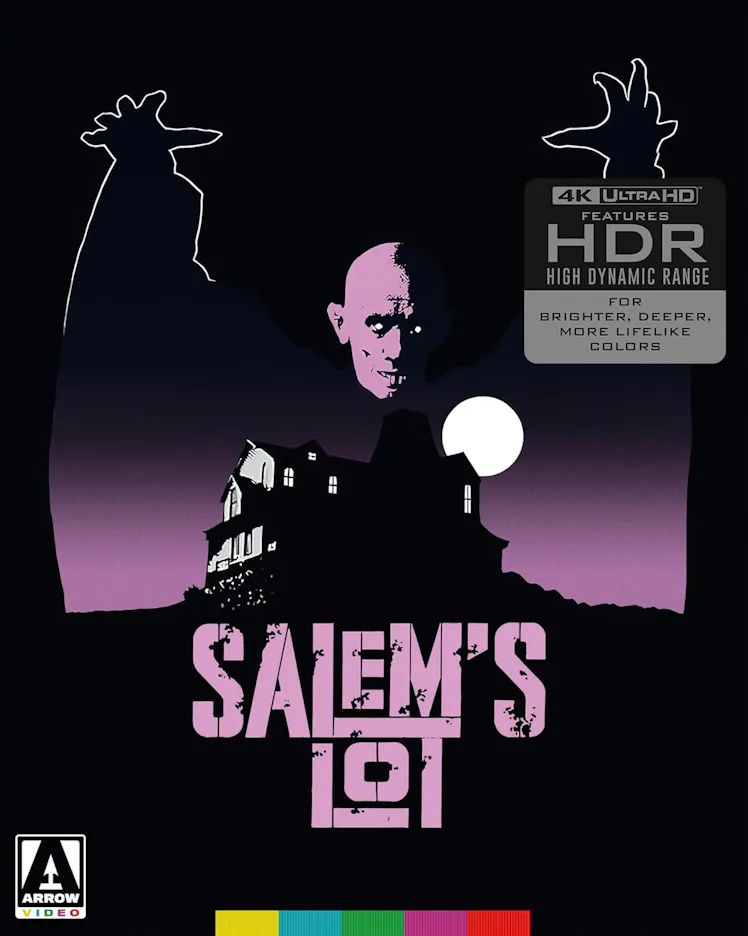
You Can Finally Watch The Most Ambitious Early Stephen King Movie On 4K
The master wants you...

Stephen King’s first novel is only around 200 pages; his follow-up Salem’s Lot is closer to 500. King’s sophomore novel, about a writer returning to a small Maine town from his childhood only to discover the townspeople are turning into vampires, is by no means his longest effort (hello, It and The Stand), but it was long enough that producer Richard Kobritz smartly decided to adapt it as a miniseries rather than a straightforward film, like director Brian De Palma did with Carrie in 1976.
In recognizing that King may be best suited for the small screen, Salem’s Lot earned its three-hour runtime with absorbing, atmospheric storytelling — and it’s now available on a prestigious 4K-restored Blu-ray.
How was Salem’s Lot received upon release?
It’s hard to measure just how popular the Salem’s Lot miniseries was when first broadcast on CBS in November 1979: The New York Times’ ratings report casually mentioned Part 1 ranking 35th out of the week’s 57 primetime shows; King’s son, Joe Hill estimates that it was viewed by around 25 million.
The miniseries had a warm critical reception — Toronto’s Globe and Mail said the series delivered the scares, and even though Time Out preferred the film’s shorter, theatrical cut, they praised director Tobe Hooper’s horror craft. King even had good things to say about screenwriter Paul Monash’s script. The series received four Emmy nominations and over the years developed a cult reputation, no doubt because so many youngsters were permanently scarred by the glinting eyes and bared teeth of the leering, levitating vampires.
Why is Salem’s Lot important to see now?

A vampire attack.
When author Ben Mears (David Soul) returns to Salem’s Lot, Maine (where else?), it’s the first time he’s been back since childhood. There’s a lot he still remembers, like his former teacher Jason Burke (Lew Ayres) and the Marsten House, an aged, creepy mansion sitting alone on the outskirts of town, supposedly haunted by its former owners’ unpleasant history. It’s currently rented by Richard Straker (James Mason), an eccentric English antiques collector, who receives mysterious deliveries in the basement and may be connected to the rash of unexplained illnesses and passings that soon plague the town.
Along with Anne Rice’s Interview with a Vampire and Richard Matheson’s I Am Legend, Salem’s Lot is one of the most significant books that brings vampires to America. For the miniseries, director Tobe Hooper replaced the poisoned sun and sweat of The Texas Chainsaw Massacre for the drab, muted tones of regional New England, lending the lengthy adaptation a subdued but simmering sense of normalcy and conformity — before an unholy sickness finally spreads.
Stephen King movies have the budget and scope to translate the author’s brand of horror into a shocking, textured visual style, but the average two-hour runtime inevitably condenses his complex backstories, incremental mysteries and ominous descents into madness. Even though King-for-TV adaptations have, on average, a poorer reputation; the televisual medium is clearly suited to his texts. After Salem’s Lot, there have been 12 other King miniseries, not including all the made-for-TV films or drama series based on his work.

Barlow wakes.
Salem’s Lot is the best Stephen King miniseries — a superlative only challenged in the streaming era by The Outsider and 11.23.63 — because the slower pace grounds in real relationships. The first hour unfolds like an ordinary, moody small-town drama, with a handsome outsider befriending old-timers, flirting with a local woman, Susan Norton (Bonnie Bedelia), and keeping tabs on her jealous ex. Seediness isn’t too hard to find — the town’s realtor (Fred Willard) is having a scandalous affair with his secretary (Julie Cobb), much to the chagrin of her drunken, violent husband (George Dzundra). As in many good horror stories, the petty squabbles of mortal losers are a mere appetizer for the real enemies: ancient mystic forces who violate the flawed human dynamics that tie American communities together.
Children are turned into demons, grieving and envious townsfolk become easy prey, and fashionable New England houses are incubators of misery and bloodshed. As Mears miserably ponders, maybe evil is attracted to evil, and the pain of Salem’s Lot will keep on compounding. Nothing can make the comfort of your idyllic, 1950s-coded life feel meaningless more than the realization that you’re being stalked by a prowling, Nosferatu-style vampire who’s older than your country by a matter of centuries.
Because King adaptations were in their infancy, Hooper and Monash were not overly concerned with honoring King’s recognizably vulgar tone, cross-literary references, or smorgasbord of extreme pet themes. When King’s morbid, blackly comic voice shines through, it’s not forced, like it was in The Monkey or It: Welcome to Derry. Watching it today, it’s uncanny how well Salem’s Lot makes you picture yourself as a young horror geek, eager but anxious to see vampires turn up on your television on a spooky autumnal evening.
What new features does Salem’s Lot Blu-ray have?
As is tradition with Arrow Video’s 4K restorations, this Salem’s Lot blu-ray is the whole package and then some. Included are brand new 4K restorations of the two-part miniseries and the shorter theatrical cut, and the bonus features are a murderer’s row of King and horror aficionados.
They include a collectors’ booklet with writing from critics, an audio commentary by former Fangoria editor-in-chief Chris Alexander, featurettes with the co-hosts of podcast Horror Queers and Heather Wixson, the co-author of In Search of Darkness.
Arrow’s typically gorgeous Blu-ray sleeves feature two original, reversible artworks, and the limited edition Blu-ray includes a Salem’s Lot town sign sticker and an original, double-sided foldout poster.