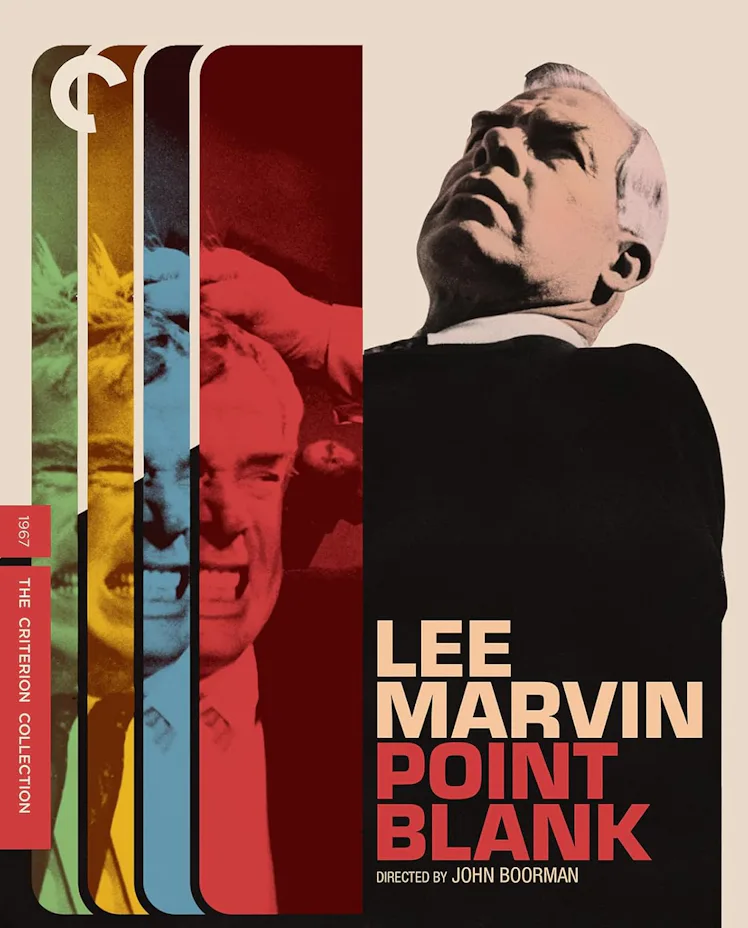
Nearly 60 Years Later, Point Blank Is Still a Shocker
John Boorman’s nihilistic, starkly beautiful 1967 crime picture hasn’t lost any of its bite.

For obvious reasons, Los Angeles is a popular setting for movies. It’s usually depicted as a sunny paradise, lined with palm trees and populated by beautiful people in bikinis and swim trunks. Even L.A. nightmares like David Lynch’s masterpiece Mulholland Drive find beauty in its bright sunlight and blooming flowers. Not so much Point Blank.
Directed by an Englishman — then-newcomer John Boorman — and starring Hollywood’s premiere tough guy Lee Marvin, Point Blank envisions L.A. as a striking, but stark landscape of concrete and mirrors whose cold, sharp modernist lines match the citizens’ sense of violent alienation. Boorman had what critic Mark Harris calls “an alien’s keen eye” for the city, rendering it in drab shades of dirty grayish white and sickly orange and green.
The story is also both familiar and alien: Protagonist Walker (Lee Marvin) is a take on the character of “Parker” from Donald E. Westlake’s popular series of pulp novels. But Boorman’s kaleidoscopic direction and Marvin’s stoic, nearly wordless performance turn the normally hot-blooded pulp genre into something much stranger, following Walker on a quest for revenge against a faceless crime syndicate known as “The Organization.” They stole his life and left him for dead, and now he wants what’s coming to him: $93,000. Cash. And he’ll kill anyone who refuses to give it to him.
How Was Point Blank Received Upon Its Release?
Point Blank was met with a mixed reception at the time. It electrified fans of French auteurs like Jean-Pierre Melville who remade crime cinema in the early ‘60s, inspired by the same films noir that birthed director John Boorman’s second feature. In this way, Point Blank is a hall of mirrors, a British director taking the innovations of European filmmakers and reflecting them back onto Hollywood.
But although the film’s stylized editing and nonlinear storytelling were far from unprecedented — both are signatures of the French New Wave, which was fairly well-known in America by 1967 — Point Blank still offended more old-fashioned critics like The New York Times’ Bosley Crowther (what a name!), who called it “lurid, tawdry, and sleazy” with “no considerate moral sense,” adding, “holy smokes, what a . . . calculatedly sadistic film it is!”
Crowther isn’t totally incorrect: The film’s own detachment from its stark violence makes it feel all the more brutal. But he does fail to account for the dreamlike surrealism that Boorman introduces into the narrative, jumping around in time and adding strange, seemingly inconsistent details so that, by the end of the film, the audience begins to question what, if anything, actually happened. The film takes on pleasure in its violence, simply observes it and moves on.
Why Is Point Blank Important to See Now?

Sharon Acker’s trancelike performance feels very modern in the age of dissociation.
Point Blank’s nihilistic fingerprints are all over movies like John Wick, another film about a violent, but soft-spoken man on a single-minded quest for something that’s very important to him, for reasons that no one else really understands. An exchange of dialogue between Marvin’s Walker and “Organization” executive Brewster (Carroll O’Connor) late in the film plays like it could have come from Chad Stahelski’s movie:
Brewster: What do you really want?
Walker: I really want my money.
Point Blank’s dreamy, detached quality was also very ahead of its time. Throughout the film, characters — particularly women — wander around in a daze, their eyes vacant and unfocused in a late-’60s version of what The New York Times recently dubbed the “Gen Z pout.” Marvin is also a stony presence, saying little and showing no emotion whatsoever: In one of the film’s most famous scenes, co-star Angie Dickinson snaps and takes out her rage on Marvin, slapping him and hitting him with her purse and fists until she sinks to the ground, exhausted. He doesn’t respond.
In an era where cultivated detachment and over-it dissociation are chic, Point Blank fits right in.
What New Features Does Criterion’s 4K UHD Disc Have?
Point Blank joins the Criterion Collection in April 2026, upgrading from previous releases with a new 4K restoration of the film supervised by director John Boorman. The special features are a combination of new and archival materials, including new reflections on the film from Jim Jarmusch (Father Mother Sister Brother).
- New 4K digital restoration, supervised and approved by director John Boorman, with uncompressed monaural soundtrack
- One 4K UHD disc of the film presented in Dolby Vision HDR and one Blu-ray with the film and special features
- Audio commentary featuring Boorman and filmmaker Steven Soderbergh
- Interview with Boorman conducted by author Geoff Dyer
- New interview with critic Mark Harris
- New reflections on Point Blank by filmmaker Jim Jarmusch
- New program on the midcentury Los Angeles architecture featured in the film, with historian Alison Martino
- The Rock (1967), a short documentary on Alcatraz and the making of the film
- Interview with Marvin from a 1970 episode of The Dick Cavett Show