Art & commerce
This webcomic made it okay to be sad online. Then its artist vanished.
The author of ‘Pictures for Sad Children’ went AWOL after a 2014 Kickstarter drama. In an exclusive interview, she explains why she had to unplug from the internet.
Paul the Ghost floats across the office to his colleague. “hey rachel,” he says. “i, um… i died about an hour ago.” Traffic accident.
Why the sheet? “well, i don’t have to, but i wanted to look ghostly.” Why come back to work? “i kind, i had a crush on you about a month ago.”
Paul decides to stick around for a bit and help out. Alas, the photocopier is on the fritz.

Thus begins Pictures for Sad Children, a webcomic that for its seven-year run, starting in 2007, set the tone for what it meant to make jokes online. It took minimalism and surrealism and wedded them to existential dread and extremely online culture. Directly and indirectly, it explored depression, anxiety, and a deep discomfort with modern life and capitalism.
Paul travels the world, finding himself just as bored and unhappy in Egypt as Oklahoma. “i’m still doing things i don’t want to do to pay for things i’m not sure i want,” Paul confesses from within a fountain in Paris.
Ultimately, Paul returns to work only to find that he can’t have his old gig back. “when an employee dies, replace them,” his boss reads from the company policy manual.
Pictures arrived at a time when Tumblr and LiveJournal meant more than Facebook. It represented a subculture of the very online, when being very online felt transgressive and maybe a little odd.
Even if it didn’t exactly tell a linear story, Pictures for Sad Children created a tiny universe with an array of strangely relatable, yet nearly indistinguishable, characters: mouthless people with stick arms, rectangular bodies, and round heads, all living in grayscale.
It was a universe where songs have names like “baby i feel bad for feeling bad.” Where the characters have porn on DVD with titles like a japanese woman fries an egg and asks you about your day, and they screen calls on a magical BlackBerry (“DAD, concerned about politics”).
The enigmatic artist behind Pictures for Sad Children became something of a cause célèbre. By her own estimation, hundreds of thousands of readers checked picturesforsadchildren.com every month. In 2008, she was interviewed by the New Yorker website. “It is a dark comic, and a good one,” wrote the interviewer in a brief introduction. “I beseech you to read it.” In 2011, more than a thousand fans contributed to a Kickstarter to fund a physical collection of the comic strips.
That’s where things went wrong.
For years, fans have searched for clues about what happened to the comics and their author.
It was a saga that would earn the Mashable headline “Comic Artist Raises $50K for Books, Then Just Burns Them.” Daily Dot reported on how the artist had purportedly “faked depression.” DNA Info called the whole affair a “Kickstarter fail.”
An angry internet mob would form, encircling the author.
Then, poof.
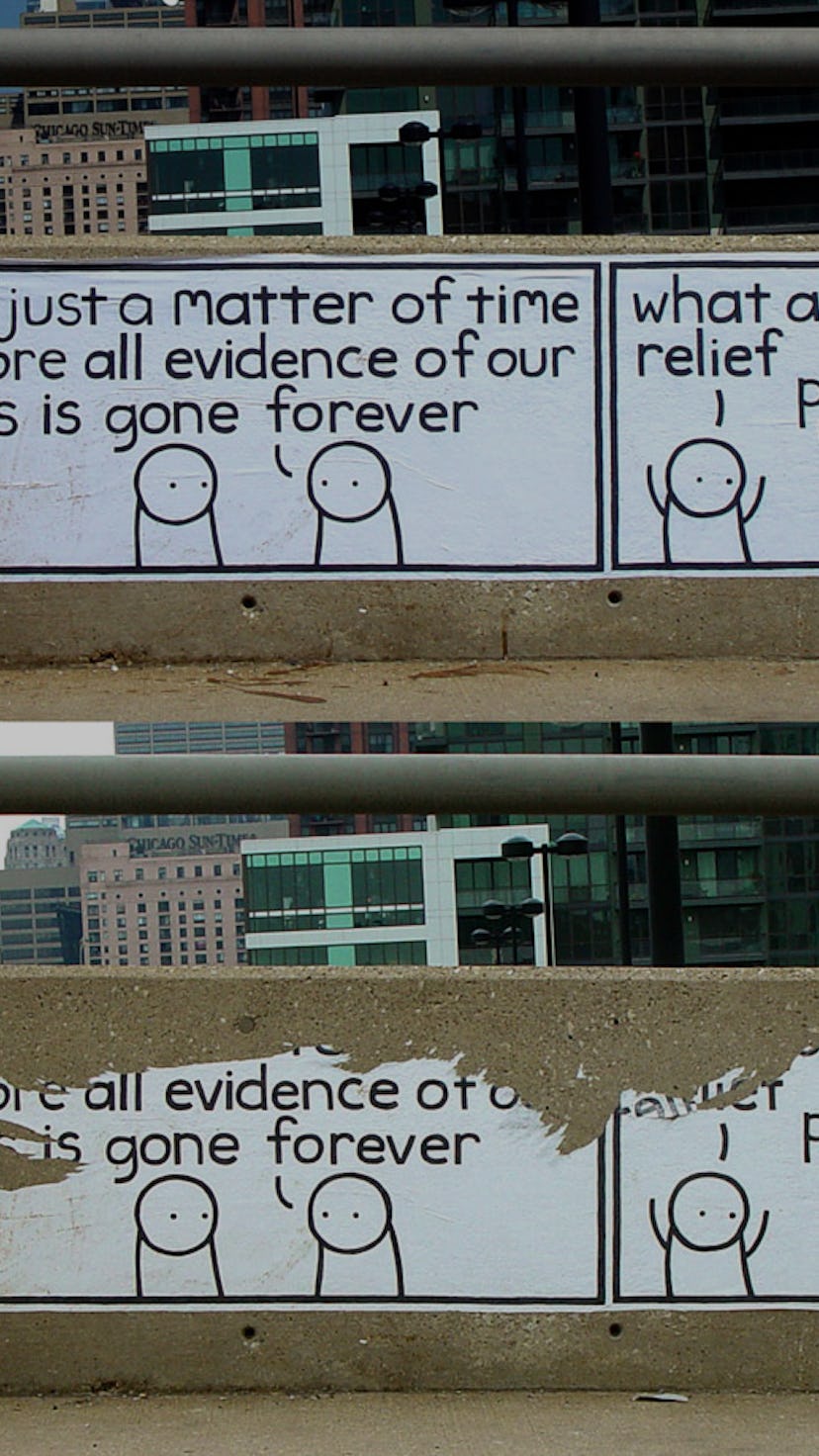
Pictures for Sad Children was gone. Its creator disappeared the comics and evaporated into binary code.
For years, fans have searched for clues about what happened to the comics and their author. Sometimes, they would be hot on the trail — finding Pictures for Sad Children living somewhere on the internet, under an assumed name. But that, too, would go offline. The network of fans worldwide would form something between a detective agency and a book club.
Now, seven years after she first vanished from the internet, the author is opening up about the experience and sharing some new art. And, given the particularly dark and absurd era, she’s just in time.
Vacuous lives
When Simone Veil emerged in the online art world in the aughts, there was no real precedent for what a digital creative industry looked like.
“The most I’ve ever charged for a [web]comic, I think, is $3,” she told Reader’s Voice in 2007.
But there was something exciting about that lack of precedent. The internet promised an open marketplace for creators to connect with fans, and Veil was in that early class of artists trying to figure it out. As her drawings and comics started to amass a small fanbase on LiveJournal and Tumblr, she began — for a small fee — to write a custom comic and either email or snail mail it to fans. She started a movement of comic creators who challenged themselves to draw one comic per hour, for a whole day.
“Getting a single moment from a day never really made me feel like I got to know the author,” she told Reader’s Voice. The hourly comic movement challenged Veil, her fellow artists, and her readers to document their day, hour-by-hour, through illustration. That didn’t quite “close the autobiographical distance,” she said. “But it is a step, and it’s an interesting enough experiment to keep up.”
It’s not hard to see the parallels between her own life and the comic’s disaffected characters.
In 2007, she put out her first book — a hand-drawn mini-collection of comics called Stevie Might Be a Bear, Maybe — with a small indie publisher. In it, the round-headed, stick-armed main character Stevie is told by another man — who looks identical, save for his spectacles — “you can pretend to be calm or happy or angry or in love, but basically people terrify you. you want to claw them in the face. they have a million issues you're supposed to relate with, but you think: why not just be simple? why not live in the woods? Stevie, this is because you are a bear.”
With her own style of existentialism coming into focus, Veil launched Pictures for Sad Children. It’s not hard to see the parallels between her own life and the comic’s disaffected characters, who are just trying to get by. In her Reader’s Voice interview, she described her millennial existence in Chicago: couchsurfing while trying to balance a loathsome corporate day job with her cartooning career.
Veil’s ambitions were fairly modest at the time. “I’m hoping to get side projects going and self-publish some kind of graphic novel or collection of illustrated poetry or some other artsy bullshit by next summer,” she said.
That artsy bullshit took off quickly. A year later, in 2008, the New Yorker cartoon desk interviewed Veil and opened with “Why so sad?”
“I suppose my comics can be a little sad, but I am not sadder than the average person, I think,” Veil responded. “Like, Charles Schulz was a pretty average dude, and did not wish that he was dead all that much. I bet whoever makes Blondie likes to eat small sandwiches, just the tiniest sandwiches in the whole world, to their shame, and the woman who makes The Lockhorns loved her husband, and now he is dead.”
By 2009, a single piece of Veil’s was going for $400. A local Chicago art gallery invited her to curate an entire evening of her work. She moved out of a crowded apartment and into her own place. She had enough support to start the book she had talked about. The utopian idea that an artist could make their own career online was coming to fruition.
But money complicates things. Especially in 2009. Napster may have been dead, but it had created the standard that, online, free is the default. Internet denizens wanted things at zero cost. When they did pay for things, they wanted the world. They wanted ownership — of both the thing and its creator.

This is the curse of capitalism: The more a customer pays, especially for something that feels like it has no intrinsic value — an image on a screen — the more they feel they own.
This problem of ownership comes up in Pictures for Sad Children. Paul the Ghost confronts a nameless figure, clearly established as some kind of tech geek.
“have i told you about how nerds destroy the world,” Paul says. Nerdy obsession with gadgets leads to “landfills full of functioning electronics,” Paul says as he smashes a computer. “there’s a special kind of nerd though. who thinks computers will overtake mankind in thirty years, changing humanity in ways incomprehensible to us now,” he continues. “so the singularity is the nerd way of saying ‘in the future, being rich and white will be even more awesome.’”
The nerdy obsessions — video games, digital devices, perhaps even webcomics — are all about focusing on something, Paul rants, “that isn’t the crushing vacuousness of their lives.”
Setting an air-thin laptop on fire, Paul the Ghost looks at his silent debate partner: “nerds do not redefine adulthood they waste it.”
A pause.
“i am not telling a joke. you are terrible.”
Up in flames
In 2011, Veil joined a then relatively novel service: Kickstarter.
If book publishers were keen to print pixel art onto dead trees, they were looking for something other than Pictures for Sad Children: She was ignored or turned down by every publisher she approached. So Veil turned to the nascent platform, asking for $8,000 to help cover the costs of printing 2,000 books.
“they will be nice and feel nice,” she promised in her write-up of the project.
She ended up raising $51,615 from more than a thousand people.
The vast majority were likely kicking in to Veil’s fund to support an artist they loved and to get their hands on an original copy of a book destined to be a collector’s item. But, looking back, some of those supporters clearly wanted to own a piece of a rising star.
Most of her fans seemed to appreciate the satire, but it was clear that many didn’t get the joke.
Out of the gate, Veil’s updates about the project were slow. She wrote about futzing around with a quixotic, yet creatively ambitious, plan to include a bunch of dead wasps she had imported from Indonesia with each copy of the book. (I’m confident it’s a metaphor for something, but I haven’t figured out what yet.)
Veil estimated the first books would arrive in July 2012. But, like many neurotic artists delivering a hotly anticipated item on schedule, she didn’t hit said deadline. That led to some anxiety amongst her backers. And that anxiety reflected back onto Veil.
After a period of silence, Veil, in September 2012, posted an update to Kickstarter: “I’VE BEEN PRETENDING TO BE DEPRESSED FOR PROFIT AND I’M SORRY,” she wrote. “I’ve done a lot of soul-searching and now believe it is my calling to be the first ‘artist’ to admit to an audience ‘I've been pretending to be depressed.’”
Two days later, Veil posted again: “I’VE BEEN PRETENDING TO BE PRETENDING TO HAVE DEPRESSION FOR PROFIT AND I’M SORRY.” A day later: “IT IS IMPOSSIBLE TO PRETEND TO DO OR SAY ANYTHING AND MY COMICS HAVE NEVER BEEN ABOUT DEPRESSION.”
Most of her fans seemed to appreciate the satire, but it was clear that many didn’t get the joke and were outraged that anyone would pretend to be depressed, much less for profit. Nevertheless, presales chugged ahead. Veil posted photos of the first copy. Her funders got excited. Books began arriving in mailboxes, and patrons eagerly flipped through the glossy pages.
Then, in February 2014, Veil posted another update: A two-minute video of a pile of books on fire, accompanied by an essay. “I shipped about 75% of kickstarter rewards to backers. I will not be shipping any more. I will not be issuing any refunds. For every message I receive about this book through e-mail, social media or any other means, I will burn another book,” she wrote.
The video set off a firestorm. There was a deluge of furious comments, tweets, Facebook posts.
Encyclopedia Dramatica, the unwanted stepchild of Wikipedia and 4chan, wrote around that time that Veil was “an artistic failure who spent a few years drawing shitty webcomics before going insane, stealing a bunch of money and telling… fans to go fuck themselves.” Later revisions would amp up the outrage, making liberal use of slurs. Whoever wrote the wiki entry sounded positively wounded.
There’s a good chance that many of the angriest commenters hadn’t read Veil’s long essay accompanying the book-burning clip. They should have: It is quite a read. In it, she talks about the economic precarity of being an artist. About how she started paying off her student loans with the modest profit from Stevie Might Be a Bear, Maybe. And how she had to quit her antidepressants because she didn’t have the funds. She offered a screencap of her checking account: $751.47.
“Before I sold my original art, I wrote a post to backers that mentioned my sexual identity,” she continued. “I felt that explaining part of my personal development over the previous year would help bring understanding and value to my absence from the internet and lack of production.” It was her quiet announcement that she was transgender. And, what’s more, that her own personal wellbeing was taking priority.
Her supposed fans didn’t see it that way. One patron wrote that they contributed at a higher rate “to thank you somehow for helping me laugh through those bad times. is this really the sort of thing you’re protesting?” Another expressed environmental outrage: “Hey, you are a prick. Do you think what you are doing is cool. There are toxins in those books and you are polluting the air. Why don’t you fly a swastika next time you burn books.”
It was clear Veil was fundamentally uncomfortable with the idea of owing people answers. She wanted to make art.
Each of the aggrieved commenters seemed to find personal injury in Veil’s actions. Like, because she took their money, she owed them something — not just a copy of a book, but something more. A piece of her life. Through the whole post, it was clear Veil was fundamentally uncomfortable with the idea of owing people answers. She wanted to make art.
People online who make art ask for money. She asked for money. And she seemed to be realizing just how toxic that transaction could be.
“I am looking for people who do not feel they need to see any ‘return’ on their ‘investment,’” she wrote.
In the essay, Veil shared the story of being a young teenager and visiting a fabulously rich friend. “In the kitchen there was a wire cage with a rat in it,” she wrote. It was a family pet but, she recalled, “the rat had a large tumor on its neck.
“The people who lived in that house had enormous wealth, and they could have used that wealth to make the rat they lived with the happiest rat in the world. Instead they chose to watch this rat die in a cage every day at every meal.”
If Veil was the rat, she had managed to gnaw out of the cage. The Kickstarter ended. Her social media vanished. The website went offline.
Left behind was the Kickstarter page, with all its furious comments.
Internet outrage
I first reached out to Veil in 2014, just after the book-burning incident. I was curious about the hate she had gotten. The internet was, clearly, shedding the kind of utopian vision it once had for itself; it was becoming meaner. I started to wonder if Veil had seen something that the rest of us hadn’t realized yet.
I emailed Veil, saying that her essay was “an interesting reflection on the modern digital economy — alienation of labor, whatever you want to call it.”
She responded within a few days, apologizing for the delay and reporting that she was “living on a buddhist monastery/organic farm in the mountains in California and doing a lot of meditation and manual labor.” She added, “It has been nice.”
She came clean on the book-burning escapade: Everyone who paid at least $15 had received a copy of the book. The ones that were set on fire were damaged or misprints that couldn’t be shipped. “I thought that might come out via social media, but it didn’t.”
“I had to go pretty well out of my way to get the internet’s ire.”
All that outrage — it had been a misunderstanding. And maybe a bit of self-sabotage. “I had to go pretty well out of my way to get the internet’s ire,” Veil confessed. She gently declined to be profiled, but suggested that perhaps she could be “a side note in a piece about people who've faced more than I have.”
But she offered a piece of wisdom that has stuck with me.
“I feel like there was something I wanted to communicate about the seemingly illusory nature of human identity, the criteria we use to decide when someone no longer gets our empathy, how little we actually know about each other, especially online,” she wrote in a follow-up email. In those questions about identity, both real and invented, “how strange it is to wrap all that in capital and ‘making a living.’”
Lots of those who provoke the internet’s rage stay and fight. Plenty stick around and hope it blows over. Today, we are constantly trying to sort through the intricacies of so-called cancel culture: Who deserves to be cast out, who deserves a second chance, and who has been wrongly accused. Whether or not outrage over Dave Chappelle’s transphobia constitutes cancelation consumes our media narrative, yet we spend precious little time thinking about how people like Veil are swarmed and harassed across the internet.
But Veil took matters into her own hands. The mob came for her, and she left town. And apparently it was liberating.
“At least I don’t have to rely on any of this to pay the rent or buy food anymore,” she wrote.

While she was gone, a whole webcomic industry sprung up, some taking obvious inspiration from her work. Webcomics became perfect vehicles for an increasingly surreal world.
Take KC Green’s “This Is Fine” Dog, who tells himself “I’m okay with the events that are unfolding currently" as he becomes engulfed in flames. Or Alex Norris’ Webcomic Name, in which colorized, unnamed blobs tend to find themselves in unexpected messes, announcing “oh no.”
“The internet is a weird unlawful place that erodes our core values,” one of Norris’ pink blobs laments in a comic. A grayscale corporate social media executive arrives in the second panel. By the third panel, the suit announces “oops we destroyed democracy,” which elicits the comic’s catchphrase: “oh no.”
Norris told me in an email recently that they’re decidedly a fan of Veil’s work. “I definitely agree with these weird internet icons representing a sort of collective psychology,” they wrote. “And it’s what was in my mind when I made the ‘oh no’ blob.”
What “Sock it to me” meant to the counterculture of the ’60s, “This is fine” and “oh no” are to our modern era.
The book club
Veil may have put a match to her online persona — her creative endeavors, her earning potential, her fanbase — but she didn’t truly disappear. She reinvented herself. In her own deeply odd, oddly deep, deeply funny way.
“Recently for some reason I changed my twitter account to ‘birdmanthefilm’ and pretended to be doing publicity for the movie Birdman starring Michael Keaton and linking to work I made on a pretend Birdman publicity site, birdmanthefilm.com,” she wrote to me later in 2014.
While the website had originally belonged to Fox, which produced the film, it had somehow fallen into Veil’s hands.
It’s offline now, but Veil fused the Alejandro González Iñárritu joint with her own minimalist comic strip. “i’m the actor michael douglas,” one of Veil’s characters says to another in a strip posted on the site. The other retorts: “you’re not fucking michael douglas. you’re not anybody.”
Veil was in a sort of internet witness protection program.
But Veil was in a sort of internet witness protection program. She didn’t advertise that she was back or market her strange parody as the return of Pictures for Sad Children. Not knowing about any of this, a small Reddit community, r/sadchildrenbookclub, was fretting her loss.
Veil’s website hadn’t been saved, and Pictures for Sad Children was hard to track down in its entirety. The last, tangible vestige of the comic came from those who had ordered a copy of the book. They held a scarce resource. And, in the increasingly capitalist internet, they would have been well-placed to auction off copies to the highest bidder.
But they didn’t. They were a book club. They resolved to share the collection, mailing copies to whoever hadn’t cracked its spine yet. Each recipient would pass on the book to the next in line — and maybe even add something more.
“When I got the box, it didn’t just come with the book that we said we would send to each other,” one user wrote. “It had a burnt DVD of It’s Such a Beautiful Day,” a quintessential internet-era indie short film that resembles Veil’s work. “It had a notebook to write our feelings in, and what I read actually made me cry.
“I have never felt so lucky to be sent something,” they went on. “It included three five dollar bills (all with faces drawn on them haha) just in case I couldn't afford the shipping.”
It’s not clear how, but eventually the book club picked up Veil’s signal: They found her Birdman tribute, and latched onto the website’s updates with fervor — they discovered secret pages featuring unreleased or archival Pictures for Sad Children comics. But the Birdman site eventually disappeared too. Over the next year, Veil’s main site reappeared, but then vanished all over again. In July 2015, one user found a Tumblr with some of Veil’s comics, but it had gone defunct.
It was like a pirate radio station, and Veil was its operator, floating on a rusted ship in international waters. If you scanned the channels when Veil was broadcasting, maybe you could catch the show.
And the book club was constantly searching the dial. “I just want the best, not to be a weird creeper you know?” one Reddit user wrote.
But Veil noticed the club’s attention, and she didn’t like it. In September 2016, she wrote to her fans on Reddit: “I do not want my work distributed.” She wanted the exclusive right to release, or delete, her own work.
“I think maybe I’m one of the internet sociopaths?”
There were layers of irony. On her fake Birdman website, she uploaded a lawsuit initiated by Twentieth Century Fox against her parody website. But that, too, was fake. At some point, a Twitter account for the guerilla art project was suspended for impersonating the real film. Now she was chastising her own fans for sharing her work.
Was it hypocrisy? Sure. Good luck existing in the digital age without a bit of hypocrisy.
“I think maybe I’m one of the internet sociopaths?” Veil wrote to me in 2014, about her on-again-off-again relationship with being online. “Not sure.”
Veil’s Birdman project tackled an interesting question that society has grappled with for centuries and has never fully resolved: Who owns art? Certainly, many who contributed to her Kickstarter felt like they helped create her work and were furious to see it disappear.
Today, investors and internet futurists want to both own and commoditize every corner of the internet through NFTs. Those non-fungible tokens are just a new way to cash in on art. To own something ephemeral. To fill the crushing vacuousness of our lives.
Back to life
Pictures for Sad Children would keep flickering in the years that followed, with new and old websites going on and offline sporadically. There was a new print book of poetry (“When a bug shows up/Take care of it/Not just the bugs you've heard of”) and some lengthy videos featuring avant garde music.
Some of her new work echoed the everyday anxieties of her old stuff, but much of it was more abstract than Pictures for Sad Children. For a while, she ran an email list where she sent out intricate drawings of shapes and called it Dream of the Red Chamber, the name taken from a renowned Chinese novel about one elite family’s fall.

At the bottom of one iteration of her reconstituted website was a conspicuous banner advertisement for Long John Silver’s.
It was another easter egg: Click it, and it revealed a special comic, supposedly sponsored by the fast-food chain. “you’ve got lupus, buddy,” one character says. “and we love you, that’s what this party is about.” A banner hangs over a mass of people: “YOU’VE GOT LUPUS BUDDY AND WE LOVE YOU.” The aforementioned restaurant catered the party but, as a Long John Silver’s employee notes, “lupus is a complex auto-immune disease even our freshside grille smart-choice menu items cannot cure.”
These pages wouldn’t last, eventually fading away from the internet. Posts on r/sadchildrenbookclub petered out after that.
I found myself thinking a lot about Pictures for Sad Children since Veil and I first exchanged emails in 2014. Moreso recently — as the world went into lockdown due to COVID-19, and we all plugged into the matrix in a huge way — her brand of lonely, anxious comedy resonated.
“Stupid times call for stupid jokes,” Kath Barbadoro wrote around that time in Vulture. “As our country’s political discourse becomes more and more absurd, the conventional tools we have used in comedy to comment on and satirize it become less and less useful, and we need to get a little weird with it.”
It just so happened that when I started to search for Pictures for Sad Children again, Veil, or at least her digital self, had come to life again, as picturesforsadchildren.online. The existence of the new site hadn’t even garnered a post on the subreddit.
I reached out to Veil again. The main email I had for her: dead. Another email: dead. I kept trying other accounts. Only one email didn’t bounce back. So I waited.
Avoiding emails
A week later, a fresh email landed in my inbox from “pf sc.”
“i’m not sure (again) that i’m the best subject for what you’re doing,” Veil wrote. She attached a series of hourly comics she had been writing, just like at the start of her career.
In one, a genderless figure sketched on a blue Post-it note hunches over a desk: “i’ve been avoiding emails.”
For months, Veil and I took turns responding to and avoiding emails. We started by discussing her brush with internet virality.
“what can a regular person do about a story about themselves that has been repeated by, literally, thousands? hundreds of thousands? of people. like, where would i even go to provide some kind of centralized story? how would i convince a totally disparate group of people to read and accept some different story, even if it were possible for me to communicate with them somehow?” she lamented. “who knows how to deal with this… and my reaction has been to just… not.”

But cherishing her right to appear and disappear at will didn’t mean that Veil had disconnected entirely. Quite the opposite: She engaged with the internet on her own terms. “i don’t think i would have survived without the visibility of trans people online,” she wrote. “i think i would have given up. offline media still hasn't shown us merely living, and i’m grateful every day for the people who encourage each other and connect and make life more livable for us.”
After trading emails back and forth through the dreary days of early 2021, I gingerly asked Veil if she would be interested in speaking over Zoom. Reluctantly, she agreed to talk, with the camera off.
Over the span of more than two hours, we walked through her career as an artist, her relationship with the internet, the very nature of fandom, the unsettling realities of capitalism, and her very real struggles with her mental health.
The decision to nuke her entire online persona — her claim to fame, her revenue source — wasn’t sudden, she says. She had always had her finger on the button.
Veil mentioned Kathy Change, a reference I confess I had to look up. In October 1996, Change, a 46-year-old climate change and cannabis activist from Ohio, distributed a poem to some friends. It read:
I’ve tried to do this several times before,
And failed.
If this is the right thing to do,
Heaven help me.
If not,
Well,
Never mind. I'll be seeing you around.
Not long after, Change doused herself in gasoline and set herself alight on the University of Pennsylvania campus. She later died in the hospital. It was a protest of the predatory nature of capitalism and, clearly, a lot of other things.
Veil’s comparison was drastic, but pretty clear. She had immolated a budding career in protest of being exploited by the very people who had supported her.
She reminisced about that role she filled on those earlier days of internet culture, but she didn’t seem to miss it.
“I resonated with a lot of people who got a college education and then were like, ‘Wait, the world sucks, and nobody told me that it sucks, and I’m sad,’” she says. “It was a relief to hear somebody talk about it and admit to how bad it is. And to admit how bad it makes you feel. And I think that is helpful to a lot of people to just hear someone else be like, ‘Oh, this bad experience that you’re experiencing? Yep. I'm getting that one too.’”
Just an abstract conversation with those masses was comforting, she says. Even exciting. “It resonated, and it was a really good feeling, because when you’re on the internet, it’s like a million voices talking to you.”
But trying to empathize with a million voices at once is exhausting. Trying to make everyone happy after they’ve given you money is impossible. It can create a toxic feedback loop.
So Veil did an inherently sane and rational thing: She went on strike, in protest of intolerable working conditions.
She finds herself saying, “Well, this hasn’t been fun; I’m going somewhere else.”
Moving on is something Veil seems especially in tune to. “I lived in a monastery, in the mountains in California,” she says. “I lived in Kansas City. I lived in Minneapolis. I lived in Texas. I lived in Albuquerque, N.M. And now I live in Iowa.” She finds herself saying, “Well, this hasn’t been fun; I’m going somewhere else. Maybe this next place will be the place for me.”
That nomad lifestyle used to be a liberating premise of the internet. That once you outgrew or cracked your digital shell, you could go find another. But increasingly that doesn’t feel like how things work. Quitting your digital life and starting anew feels so uncommon and strange enough that Veil’s story merits headlines like “How To Disappear Completely From the Internet.”
Through our conversation, Veil makes it clear that there are things she still wasn’t ready to talk about. That some things had really wounded her. When I hesitantly broach the Kickstarter drama, she goes quiet. I can hear the sound of her quietly crying.
Uncertain future
In the decade since Veil quit the original incarnation of Pictures for Sad Children, there has been a steady stream of things written about her and her exit from the internet. Many have peddled the narrative that she made off with her Kickstarter cash, some have traded in vile insults and slurs about her. And, to some degree, that followed her — or, at least, her dead name. And that feeling that Veil owes everyone something has continued.
But maybe Veil’s fans owed her something. Maybe the creator–fan relationship isn’t just transactional. That there ought to be a little more humanity to it.
All Veil really needed was empathy. That’s all anyone needs, really. A touch more empathy would go a long way, especially online.
Because for so many, underneath all the vitriol and anger, the internet is still that sanctuary that we were once promised. The one that Veil is still trying to plug into: Where trans people or those struggling with their mental health or even those just looking for a laugh can find find a bit of validation.
“I’m a little terrified about the future.”
“I’m going to get personal,” she warns me. “I didn't find myself being valued in my day-to-day life.” But, she says, “this weird artwork that went viral for some years — it’s kind of the part where I am most practically valued in my life.”
Veil’s decision to blow up a potentially lucrative art career didn’t come without consequences. “I’m a little terrified about the future and i haven't ever had health insurance?” she wrote to me in January. But it’s hard to find any evidence of regret in her decision. “at least i'm not always being harassed i guess.”
Her comics have even taken on a more cautiously optimistic tone.
On the landing page of her most recent website there was a simple color comic. (The site is still live, but the image is broken.)
“I DON’T KNOW IF THERE’LL EVER BE DAYLIGHT AGAIN,” reads one panel.
And in the next, a yellow sun emerges from a purple hillside.

Correction, 12/6/21: The original version of this story suggested Veil joined the hourly comic challenge. In fact, she started it.
